

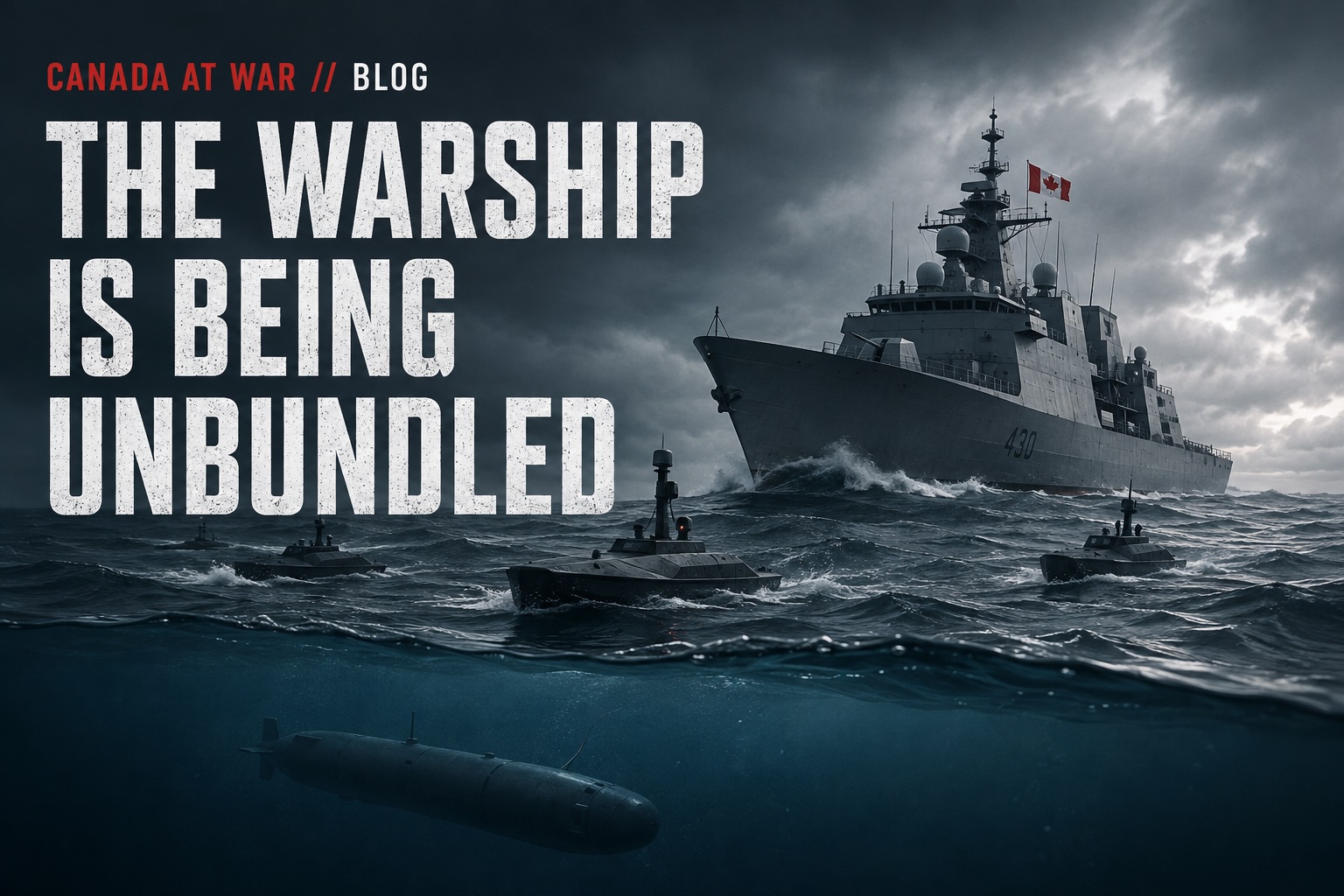
The Warship Is Being Unbundled
Recently, I’ve been seeing more and more articles that point to a sea change (pun very much intended) in how navies fight.
For most of the modern naval era, we have tended to think of a warship as a single package. A frigate or destroyer carries its own radar and sonar, its own missiles, its own communications systems, perhaps a helicopter, and the sailors needed to operate all of them. Put enough of those ships together, and you have a fleet.
That model remains powerful, but it also concentrates a great deal of capability, cost and risk in one hull.
Increasingly, navies are asking a different question:
What if all of those functions do not need to be carried by the same vessel?
That’s the question behind a growing range of uncrewed naval systems now being developed in Britain, Sweden, the United States, and elsewhere.
The interesting shift is not simply that drones are going to sea. It is that some of the functions traditionally bundled within a single warship are beginning to migrate to separate platforms.
Britain and the “Hybrid Navy”
The Royal Navy is unusually explicit about where it thinks this is going. It calls the concept the Hybrid Navy: crewed ships, submarines and aircraft operating alongside increasingly capable uncrewed systems.
Britain's current plans include three new families of uncrewed naval systems. Type 91 is intended to carry missiles and increase the fleet's firepower. Type 92 will provide uncrewed sensing to hunt submarines across the North Atlantic. Type 93 will be an extra-large underwater vehicle designed to operate alongside crewed attack submarines. The Navy is simultaneously expanding autonomous mine warfare and experimenting with ship-launched one-way strike drones.
What’s interesting here is the division of labour. A frigate no longer necessarily has to carry every sensor and weapon it may need. Some sensing can be pushed away from the ship. Some weapons can be distributed onto other platforms. Dangerous or repetitive missions can be handed to systems that do not require a crew.
The crewed ship remains important, but it increasingly becomes one part of a larger system.
Sweden Goes Below the Surface
Sweden is pursuing a similar idea underwater. Saab is developing a Large Uncrewed Undersea Vehicle for the Swedish Defence Materiel Administration. Its initial roles include underwater surveillance, seabed monitoring and the protection of critical infrastructure.
Importantly, the first version is not being presented as an autonomous attack submarine. Its primary purpose is sensing. That gives us clues as to how this transition is likely to happen.
Navies do not have to leap immediately from manned submarines to robot submarines carrying torpedoes. They can begin by moving the missions that benefit most from persistence and risk tolerance onto uncrewed systems.
An autonomous underwater vehicle does not need bunks, food, watch rotations, or the life-support systems required to keep a crew functioning beneath the surface. It can potentially remain on station longer, operate in places where losing a crewed submarine would be unacceptable, and spend its time doing work that is valuable but not necessarily worth dedicating a major warship to.
Once those systems can navigate, observe, and communicate reliably, the range of possible missions begins to expand.
Moving the Weapons, Too
Of course, the next natural step is to distribute not just sensing, but firepower. The United States is already experimenting with uncrewed surface vessels capable of carrying missiles. During RIMPAC 2026, a Saildrone Surveyor operated with a launcher for Joint Air-to-Ground Missiles.
It is still experimental, but the logic is significant.
Traditionally, the chain looks something like this:
The ship detects the target → the ship identifies it → the ship fires the weapon.
A distributed system can separate those steps.
One platform may detect the target. Another may help classify it. A crewed command node may make the engagement decision. A different uncrewed platform may carry the weapon.
That changes the value of the individual hull.
A destroyer or frigate has only so many missile cells. Once those weapons are gone, the ship may still be able to sense and command, but its offensive power has fallen sharply.
If some of that magazine can instead be carried by cheaper uncrewed vessels, the fleet can distribute both risk and firepower.
That does not make the crewed ship obsolete, but it certainly changes what the ship is for.
Ukraine and the Pressure of War
Ukraine has demonstrated a very different version of the same trend. Its maritime drones are generally much simpler than the sophisticated autonomous systems being developed by major navies. Many are essentially fast, remotely operated explosive boats: the modern descendant of fireships.
And they have already forced the much larger Russian navy to react. Ships have had to alter their operating patterns, strengthen port defences, and devote considerable effort to countering relatively inexpensive uncrewed threats.
That may be the more important lesson here: a system does not have to replace a warship to change naval warfare, only create enough military effect that the opponent cannot ignore it.
In war, technologies that might spend years under evaluation may be fast-tracked into service, and the more potentially useful the technology, the higher the pressure. Commercial technology gets adapted, failure rates that would be unacceptable in peacetime become tolerable, and commanders experiment because the alternative is often worse. That means the most dramatic changes may not come from the technologies currently entering service but from what happens to those technologies after six months of serious combat.
The Fleet Becomes More Than Its Ships
Put these developments together and a different model of naval power begins to emerge. A crewed ship might still provide command, sophisticated communications, air defence, and human judgement. Around it, however, other platforms could provide:
persistent surveillance
anti-submarine sensing
mine warfare
reconnaissance
decoys
additional missile capacity
one-way strike
underwater monitoring
In that situation, evaluating and comparing naval power is no longer simply a matter of counting hulls or tonnage the way we’re used to.
None of this means distributed fleets are automatically superior, however. They come with new vulnerabilities: communications can be jammed, navigation spoofed, and data links broken. Just like on land, autonomous systems can be deceived, and software can fail at exactly the wrong moment.
A fleet that spreads its combat power across many platforms may be harder to destroy physically, but it becomes more dependent on the resilience of the network connecting them.
The contest begins to shift from ship against ship toward network against network.
From Invasion to What Comes Next
The naval encounters in Invasion remain deliberately recognizable as an evolution of contemporary warfare.
The ships are still ships. Submarines and aircraft carriers are still critical. Missiles, aircraft and shore batteries operate within a framework that a present-day naval officer would broadly recognize.
There are some uncrewed systems at the edges of that battlefield—the Narwhals used during the Battle of Esquimalt, for example—but they are additions to the existing model, not a replacement for it.
What is more interesting to me now is what happens after the war has begun.
By the time of Insurrection, neither side is operating in the world that existed before the invasion.
The United States has had time to learn from the opening campaign. So have Canada and the other members of the Sentinel Compact.
Systems that were experimental before the war can be rushed into service. Uncrewed platforms designed for reconnaissance can be given new missions. Existing weapons can be mounted on platforms their designers never originally intended to carry them. Doctrine can change around whatever proves useful.
That does not require a sudden technological revolution.
Much of the technology already exists.
What changes is the urgency.
For centuries, naval strength has been measured largely by counting ships.
The next major shift may come when the ship itself stops being the basic unit of naval power.