
Why I Chose to Write About an American Invasion of Canada
When I first conceived Invasion, the idea that America might invade Canada seemed preposterous.
For decades, Canada and the United States have been bound so closely—economically, militarily, and in some ways culturally and politically—that the notion of one invading the other was, let’s face it, insane.
That’s what made it such a powerful premise for a novel. The question wasn’t: What if America invaded Canada? It was: What would have to happen before something so unthinkable became possible?
What would have to change?
That question opened up a much larger story about the erosion of institutions, the collapse of alliances, political radicalization, and the danger of assuming that relationships between countries are permanent simply because they have lasted a long time.
As simple as it would have made my writing, an invasion couldn’t just happen because the plot required it. A functioning constitutional democracy, constrained by law, institutions, alliances, professional norms, and public accountability, doesn’t wake up one morning and decide to invade its closest neighbour.
Something fundamental would first have to change.
That meant the invasion wasn’t the start of the book. It was a destination that I had to reach. To justify it, I had to imagine how NATO might decay, how political hostility could become normalized, how institutions could be captured or weakened, and how two countries that had spent generations treating one another as friends could come to see each other very differently.
The road to war became almost as important to me as the war itself.
The plans already existed
There was also a historical starting point for the military side of the story.
I had known about War Plan Red for years. In the interwar period, American military planners developed a contingency plan for war with the British Empire that included an invasion of Canada. So, when I began working seriously on Invasion, one of the questions I asked myself was: if the United States updated that plan for the 2030s, what would it look like?
Of course, the Americans weren't the only ones who had thought about this. Canada had its own plan, developed even earlier, in 1921, called Defence Scheme No. 1, which started from a brutally realistic assumption: Canada could not defeat the United States in a conventional war.
A Canadian officer, James "Buster" Sutherland Brown, spent months masquerading as a holidaymaker in the border states, mapping troop deployments and infrastructure vulnerabilities. (Side note: Brown was Canada’s Director of Military Operations and Intelligence, which makes him something of a real-world institutional ancestor to Marcoux.)
The plan Brown developed was as wonderfully audacious as it was madcap. Canadian flying columns would cross the border and strike towards Seattle, Great Falls, Minneapolis, Albany, and other cities. Nobody expected them to hold those objectives, however. The idea was to simply disrupt American mobilization, draw forces away from the main invasion routes, and buy time for British and Commonwealth reinforcements to arrive.
That gave me my second question: what would a modern version of that strategy look like a century later? Not cavalry and flying columns heading for American cities, obviously. But the underlying problem was remarkably familiar. Canada would still be confronting an opponent it could never hope to match conventionally. It would have to disrupt, delay, deny, disperse, and survive long enough for other pressures to come into play.
And that led naturally to the military problem at the heart of Invasion.
An unwinnable conflict
A century later, that fundamental imbalance hasn't changed. Canada could not defeat the United States in a conventional war. Even with ten years to prepare, it would be implausible to match American numbers, air power, industrial capacity, or military spending. So, the story could not rely on matching tanks with tanks or aircraft with aircraft and somehow having Canada come out on top. It had to become a story about resilience, geography, denial, resistance, alliances, and a nation's ability to keep functioning under overwhelming pressure.
That became one of the central strategic ideas behind Invasion: Canada did not need to become stronger than the United States, but it had to recognize the imbalance early enough to prepare for a war in which conventional strength couldn’t be allowed to determine success.
The question was less about whether Canada could win major battles and more about whether overwhelming battlefield superiority could actually be converted into political control. Vietnam, Iraq, Afghanistan: we’ve seen again and again since WW2 that occupying a country and controlling it are not the same thing. The Troubles in Northern Ireland similarly showed us that even a comparatively small insurgency can be extraordinarily difficult to contain when its members are embedded in the same communities, speak the same language, and cannot simply be identified on sight.
And let’s face it: invading Canada would put millions of angry, hostile civilians behind the front lines. People who, in many cases, would look and sound exactly like the invaders, but who knew the terrain, the communities and the infrastructure, and could draw on local support an occupying army simply couldn’t match.
When I realized that, I knew I’d identified the military problem I wanted to explore: invading Canada wouldn’t be kicking a hornet’s nest. It would be covering yourself in honey, then climbing inside one.
Putting Canada at the centre of the thriller
Another objective that was important to me was to make Canada the focus of a military thriller. Canada is often treated as background, support, or scenery in the genre. Canadian forces may appear as allies, and its cities may provide secondary locations, but Canada itself is rarely the country whose institutions, geography, vulnerabilities, and choices drive the story.
In Invasion, Canada isn’t just the setting. It’s a strategic problem that both sides—aggressors and defenders—have to figure out. That is one reason why so much of the ground war eventually centred on Southern Ontario. Toronto is an obvious political and economic objective, but reaching it, supplying an occupying force, and controlling the approaches to the city are very different challenges.
The same principle applies across the novel. The fictional war had to take place on recognizably Canadian ground, shaped by Canadian realities.
When the impossible starts feeling less impossible
The scary thing is that what started as an author’s crazy thought experiment feels less absurd than when I started. Political events over the last two years have started to look uncomfortably like the opening moves of the ten-year ‘phony war’ that I’d imagined as the run-up to 2036.
Even so, I still think that a literal military invasion—American tanks crossing the border and occupying Canadian territory—is unlikely.
But economic assaults? Diplomatic pressure? Interference in our democratic processes? Cultivating collaborators and quislings? I am less comfortable simply laughing those possibilities off than I once was.
More importantly, many of the pressures that interested me when I began writing now feel much less abstract: questions about sovereignty, political interference, military readiness, institutional resilience, and how much Canada could really rely on its allies in a crisis.
My aim was never to chase the news or write a thinly veiled version of current events, but the story asks what could happen if several recognizable pressures were allowed to intensify, interact, and harden over time.
In many ways, one of the hardest parts of finishing the novel was keeping the fiction ahead of political events.
I’d already planned and begun writing the broader political trajectory that would eventually make the invasion possible. Yet, even as I was editing, reality began to move closer to some of the questions I had been exploring. I even joked to friends, “I need to get this out. Otherwise, it’ll look like all I did was read the news.”
And now, it is out.
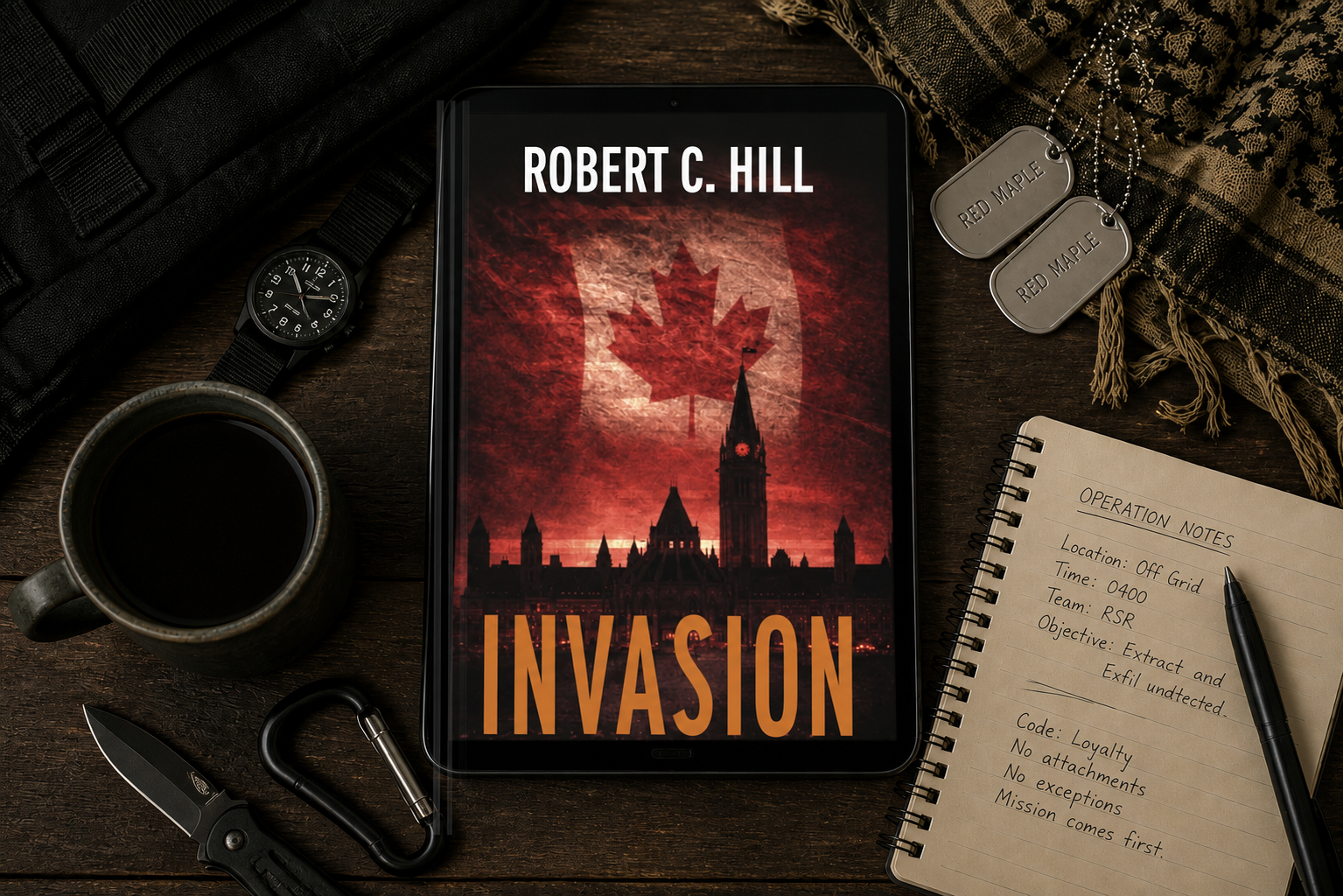
Invasion, Book One of the Canada at War series, is available now: robertchillbooks.com/getinvasion