

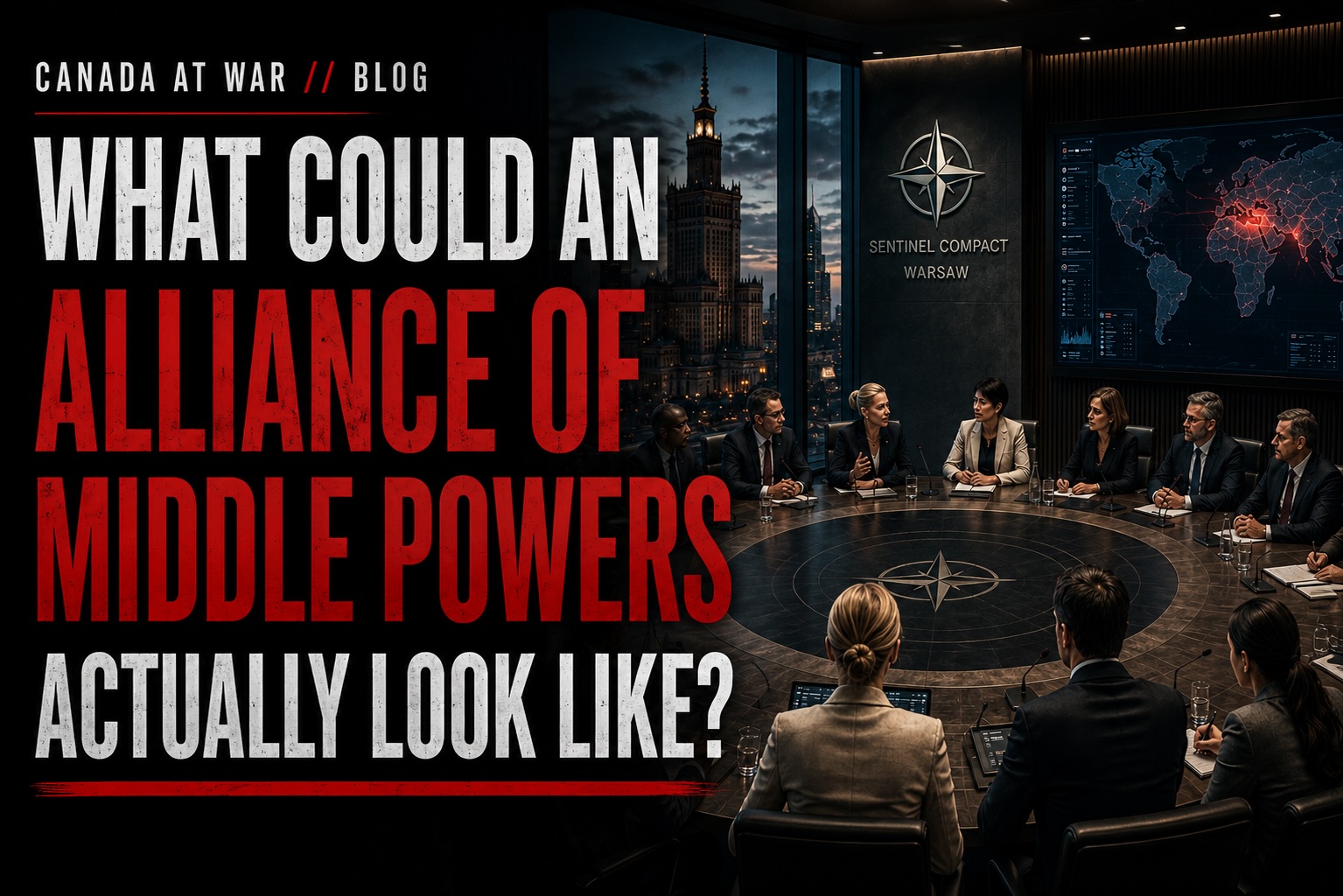
What Could an Alliance of Middle Powers Actually Look Like?
When I started writing Invasion, one of the first things I had to consider was what the world would look like if a future America opted out of the rules-based world order.
The answer I came up with was the Sentinel Compact, an alliance of democratic middle powers collaborating to build strategic autonomy from the dominant superpowers.
All of this happened well before Mark Carney's Davos speech, and I’d love to claim some extraordinary gift of geopolitical foresight. The truth, however, is rather less impressive: I had a plot problem to solve.
Invasion is set in 2036, in a world where years of political turmoil have transformed the United States from Canada’s closest ally into its greatest threat.
But that raised an obvious question: if the U.S. could no longer be relied upon, what would Canada do?
It could strengthen its own military, of course, build up its defence industries, protect its infrastructure, and reduce its dependence on American technology.
But a nation with a population of 40-odd million people isn’t going to become a superpower. Neither will Australia. Or Poland. Or Spain. Or Sweden.
Even countries like Britain, France, Germany, and Japan, while they are substantial powers in their own right, are in a different weight class from the United States or China.
Then, in January 2026, Mark Carney stood up at Davos and described a world in which the superpowers would increasingly use their size to dictate terms. Countries in the middle faced a choice: compete with one another for the favour of those powers, or work together to create what he called a “third path with impact.”
By March, he was talking explicitly about Canada creating a “dense web of connections” with other countries, building coalitions around different issues so middle powers could increase their collective influence and strategic autonomy.
That caught my attention, because we had arrived, independently, at essentially the same problem.
Independence isn't enough
For most of the postwar period, countries like Canada benefited enormously from an international order built around American power.
That system had a military dimension in the shape of NATO and NORAD, but the relationship (and the dependency) went much deeper, encompassing intelligence, technology, trade, financial systems, defence procurement, supply chains, communications and industrial integration.
That's all well and good when the country at the heart of the system is a dependable partner.
It becomes rather more uncomfortable when it isn't.
And simply declaring yourself more independent doesn't solve the problem.
If another country supplies your weapons, provides the intelligence you depend upon, hosts the cloud infrastructure carrying your data, dominates your largest export market, and controls technologies embedded throughout your economy, you can talk about political sovereignty all you want: you’re still extraordinarily vulnerable to pressure.
The answer I eventually arrived at for the world of Canada at War was something you might call sovereignty through redundancy: it's much harder to coerce a country that has somewhere else to go.
That means alternative markets. Alternative suppliers. Alternative communications networks. Alternative intelligence relationships. Alternative sources of military equipment.
And those alternatives become considerably easier to build if a group of countries builds them together.
So what would an alliance of middle powers actually look like?
Probably not like NATO minus the United States.
The biggest difference is not what the Compact does, but how power is distributed within it. NATO has always been a multilateral alliance with one overwhelmingly dominant military power at its centre. The Sentinel Compact, it seemed to me, would be deliberately built so that no member occupied that position.
Instead, member states develop particular strengths within a shared strategic and industrial system. One might specialize in combat aircraft, another in artillery, cyber defence, naval systems, Arctic warfare, satellite technology, or whatever. But those capabilities do not become new sources of dependency. Technology, production rights, standards, and supply chains are all shared across the alliance so that other members can build, maintain, adapt, and sustain them.
The result is distributed capability. Canada does not need to design every aircraft, missile, satellite, or communications system itself. It needs access to systems it cannot be cut off from by the political decisions or whims of one dominant supplier.
Intelligence works on a similar principle. While Sentinel members share information broadly, SIGPAC, a smaller partnership within the Compact, provides the technology and capabilities for satellite, intercept, and other SIGINT collection. The point was not to create Four Eyes (Five Eyes without the United States), but to build an intelligence architecture in which capabilities are distributed among co-equal, trusted partners.
That is probably the most important distinction between Sentinel and the alliance it replaced: no single country is indispensable.
And that is where the fictional alliance began to look unexpectedly similar to the argument Carney is now making in the real world.
He has talked about cooperation not simply in defence, but in critical minerals, artificial intelligence, trade, and strategic industries. His “variable geometry” model envisages different groups of countries cooperating on different problems, rather than attempting to build one enormous institution that does everything.
The Sentinel Compact takes that logic further.
In my fictional timeline, repeated crises eventually cause those overlapping relationships to harden into a permanent alliance.
That doesn't mean such an alliance would have to include every democracy on Earth.
India, for example, has its own tradition of strategic autonomy and might have little appetite for joining a bloc that constrained its freedom of action. Other countries might cooperate economically but remain outside its military structures.
The key question wouldn't simply be, Do we like each other?
It would be:
Are we prepared to become strategically dependent upon one another?
Which brings us to the awkward bit
It is easy to create an all-singing, all-dancing alliance on paper. Rainbows and unicorns for everyone.
But what happens when membership has a cost?
It's one thing to agree to cooperate when doing so is economically convenient, politically popular, or strategically safe. It's quite another when standing alongside an ally means jeopardizing trade, confronting a much more powerful country, or asking voters to accept genuine risk on somebody else's behalf.
That became an important part of the Sentinel Compact as I developed it for Invasion. The Compact couldn’t simply be a convenient geopolitical cavalry that would automatically ride over the horizon whenever Canada needed help. Its members have their own governments, voters, economies, interests, and thresholds for escalation.
And I soon realized that without a dominant member, the alliance faces an unexpected problem: a group of middle powers may collectively possess enormous economic, military, and technological strength. But that collective power exists only when they can agree on how and when to use it.
Without one overwhelmingly powerful country capable of setting the direction, an alliance built around genuine equality may find its most consequential decisions harder, not easier.
That is both its attraction and its weakness.
Perhaps that is the real question
The Sentinel Compact was a solution to a fictional problem: what would Canada do if the geopolitical assumptions it had relied upon for generations suddenly stopped being true? My answer was that Canada wouldn't replace one dependency with another. It would help build a system designed never to depend on a single nation again.
Now, Canadian foreign policy has begun talking in remarkably similar terms about strategic autonomy, resilient partnerships, and middle powers combining their influence rather than negotiating individually with great powers.
Carney has argued that countries such as Canada, Australia, Europe, Japan, and South Korea collectively possess far more economic, technological, and cultural weight than we sometimes assume.
So maybe the ingredients of an alliance of middle powers already exist.
The difficult part isn't imagining what it might look like. It’s deciding how much countries would be willing to share, how much they would be willing to risk for one another, and whether cooperation would survive the first moment when acting together became genuinely costly.
Ultimately, that may be the paradox facing middle powers in the world now emerging: to preserve their independence, they may have to learn to depend much more heavily on each other.
Invasion is available now: robertchillbooks.com/getinvasion