

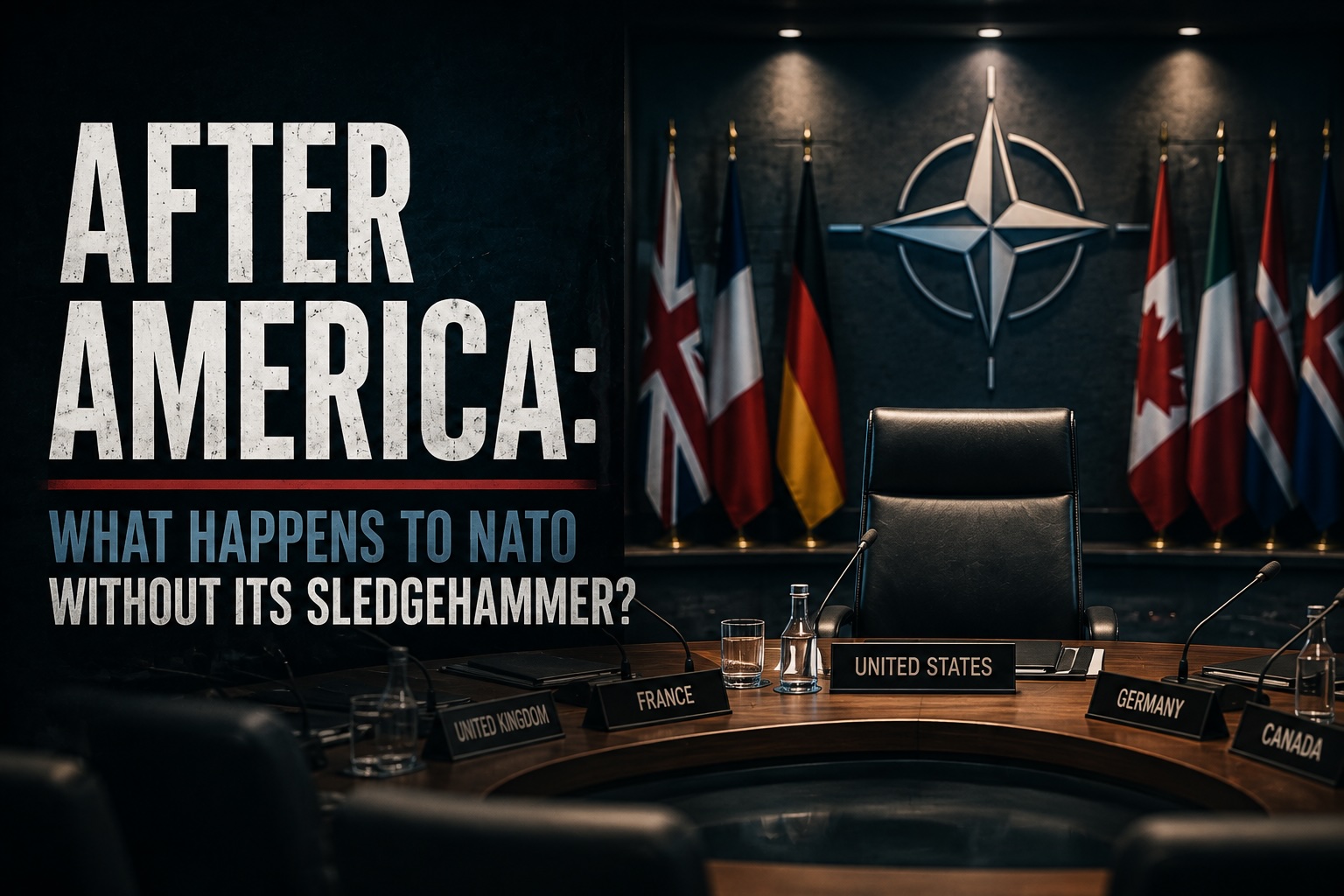
After America: What Happens to NATO Without Its Sledgehammer?
NATO was built for a particular world. When the alliance was created in 1949, the threat was clear and largely geographical: the Soviet Union dominated Eastern Europe, Western Europe was exhausted by war, and the United States had the military and economic power, and the political will, to prevent Moscow pushing farther west.
The solution was an alliance centred on the North Atlantic, with American power providing much of the muscle behind it.
In the fictional world of Canada at War, that arrangement eventually breaks down. By the early 2030s, the existing international security system no longer fits the world around it, and the country NATO relied upon most has become part of the problem.
What happens if America leaves?
In the world of Canada at War, the U.S. leaves NATO in 2028. Which begs the question, what happens to NATO when the major power that anchored the alliance quits?
The short answer is that NATO gets weaker. Much weaker. The United States isn't just one of 32 members. It supplies a huge amount of the military capacity that makes the alliance work: weapon technology, intelligence and surveillance, global logistical reach, strategic airlift, aerial refuelling, satellites, long-range strike, munitions, missile defence, command infrastructure and, ultimately, a major part of NATO's nuclear deterrent.
But Europe doesn't suddenly become defenceless if America is removed from the mix. Britain and France are nuclear powers in their own right. In recent years, Poland has grown into a major military force. Germany, France, Britain and other European countries have substantial armed forces, with the capability for global force projection, and defence spending and production are already rising.
But there is a difference between having armies and having everything needed to allow those armies to operate together, move quickly, and sustain a major war. Europe could replace those capabilities. It would take money, industrial capacity and time, but it could be done.
And that was initially how I thought about NATO's collapse when I was building the world of Invasion. America walks away, so the remaining allies rebuild what they have lost. Simple enough on the surface, but it doesn't solve the bigger problem.
The security map has grown
Russia remains a major security threat to Europe, but the strategic world no longer stops at Europe's borders.
China is primarily a Pacific military power, but a confrontation involving China and Japan would disrupt shipping, semiconductor production, communications, and supply chains around the world within days. COVID gave us a pretty brutal demonstration of how quickly disruption in one part of the world can affect everyone else. So has the war in Iran.
The Arctic adds another dimension. Canada, Russia, Denmark, Norway and Iceland all have direct interests there, and China describes itself as a “near-Arctic state.” What happens in the far north increasingly matters well beyond the countries that actually border it.
And then there are threats that barely respect geography at all: cyberattacks, satellites, financial systems, undersea cables, communications infrastructure. Attacks on these can originate and happen anywhere.
So, the old idea that European, Pacific, and North American security can be treated as largely separate problems is becoming increasingly difficult to sustain. For now, the United States helps make that separation work because it sits at the centre of several different alliance systems at once. Take it away, however, and the disconnect suddenly becomes all too obvious.
NATO already works closely with Japan, Australia, New Zealand and South Korea. But if America is no longer linking those security systems, why should those countries remain partners in a European-centred alliance?
Europe needs partners in the Pacific; Japan and Australia need partners in Europe; and if you draw the map one way, Canada spans the Atlantic, Pacific, and Arctic. But finding a new country to sit in the middle isn’t the answer. Especially if it is, essentially, the same map.
So perhaps the real question isn’t:
How does NATO survive without America?
Perhaps it is:
Why would we recreate NATO at all?
Something bigger than NATO
That was the point at which the Sentinel Compact started to take shape. What emerged in the Canada at War world is broader than NATO, but the important difference isn't simply more flags around the table.
The Compact is built for a different strategic map. Japan and Australia aren’t junior partners of a European/Northern alliance. They are full members. A crisis affecting them belongs in the same strategic conversation as one affecting Poland, Iceland, or Canada.
Of course, that doesn’t mean every member suddenly sees the world in the same way.
A Polish government will inevitably care more urgently about Russia than about events in the Pacific. Japan will see China rather differently from Spain. Canada will have Arctic concerns that matter rather more in Copenhagen or Oslo than they do in Madrid.
That tension doesn’t disappear. It simply becomes something the alliance has to manage.
And perhaps that is the real challenge of building a security system for a world in which threats are increasingly global: not convincing every country that every crisis matters equally, but convincing them that crises elsewhere can no longer safely be treated as somebody else’s problem.
History doesn't repeat itself, but it rhymes
There is something I rather like about Canada’s involvement in creating the Sentinel Compact, because Canada has been here before. In 1949, it helped build NATO because the institutions that existed before it were no longer sufficient to address the security problems the world faced.
In my fictional 2030s, it reaches much the same conclusion.
NATO may well be capable of surviving without the United States, but survival isn't really the interesting question.
If the threats facing democratic states now stretch across Europe, the Arctic, and the Indo-Pacific, and if no single superpower can safely be relied upon to hold those regions together, then an alliance designed around the North Atlantic may not be enough.
Sometimes the problem isn't replacing the missing sledgehammer.
It's realizing you need a different toolbox.
Book One of Canada at War, Invasion, is available now: robertchillbooks.com/getinvasion