
Thinking the Unthinkable
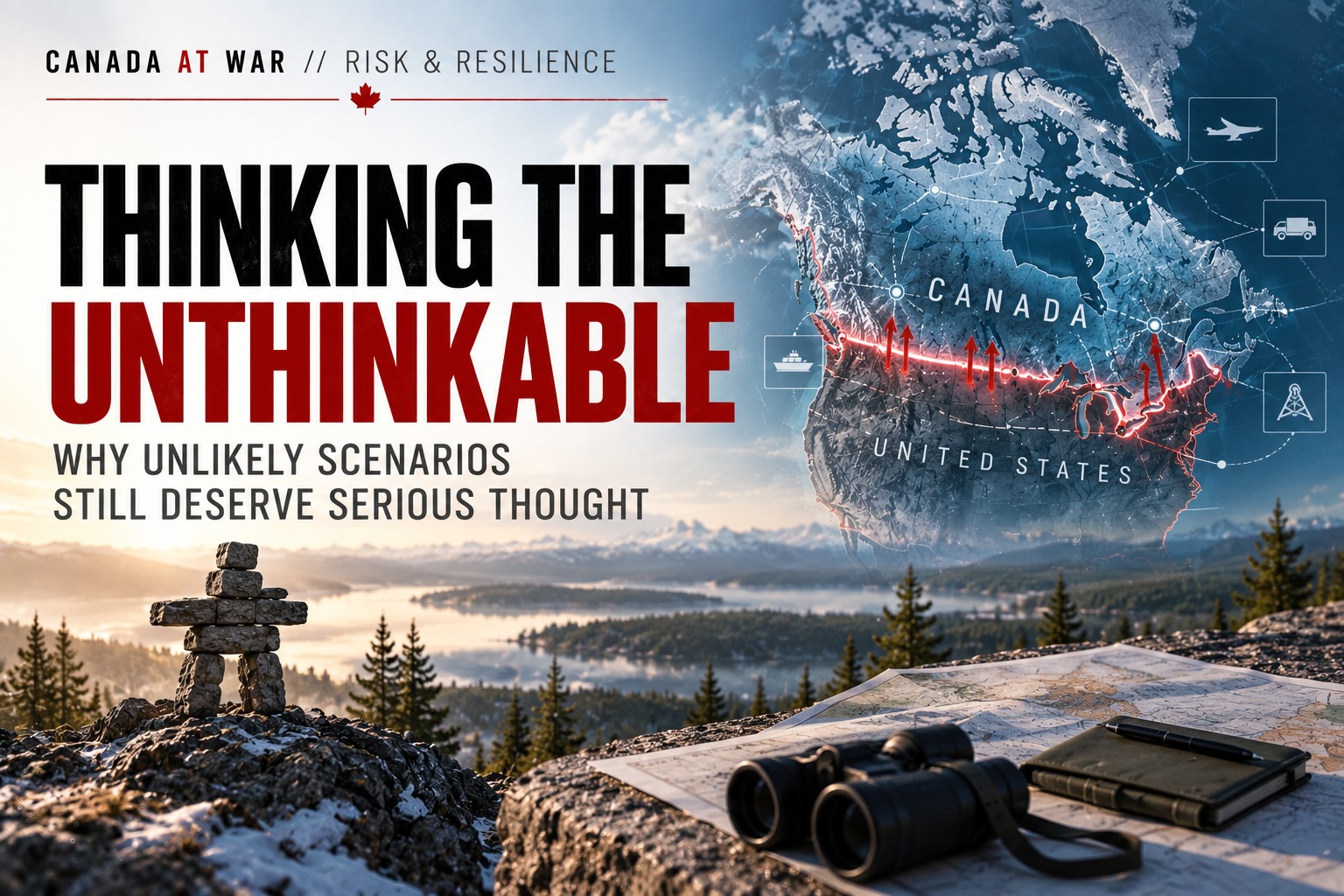
Last weekend, news cycles and talking heads here in Canada were dominated by reports that Prime Minister Mark Carney had confirmed in a New York Times interview that his government had considered the possibility of U.S. military action against Canada.
That’s not the kind of thing anyone expects to hear from a Canadian prime minister. And, inevitably, it prompted the question: Does Ottawa seriously think the United States might invade Canada?
Only that wasn’t what Carney actually said.
He described the possibility as an “extreme tail risk” and explicitly said it was not the government’s base case.
The point is that people responsible for the security of a country have a duty to consider even vanishingly unlikely events when the consequences would be severe. As Carney told the NYT, “That’s just risk management.”
And he’s absolutely right. In fact, I’d be considerably more worried if the Canadian government wasn’t considering it.
That doesn’t mean I think American tanks are going to roll across the border. Neither does Mark Carney. Thinking through such a scenario is not evidence of panic, paranoia, or some secret government conviction that war is coming. All it means is that somebody asked, What if?
We ask that question all the time in situations where the consequences of failure matter. Buildings have fire plans even though nobody expects them to burn down. Companies prepare for cyberattacks they hope will never happen. Governments plan for floods, pandemics, power failures, terrorist attacks, and other emergencies whose timing and probability they cannot know.
You do it every time you buy an insurance policy: you thought about something that could go wrong and made a plan to deal with it.
So, why is Carney’s statement being treated so differently?
Nobody sees an evacuation diagram on the back of a hotel-room door and concludes management expects the building to burn down before breakfast. But when the contingency is politically uncomfortable, we often react differently. Merely discussing it can be treated as predicting or even advocating it.
That confuses two very different questions: What do we think is likely to happen? And: What would we do if something unlikely happened anyway?
Serious governments need answers to both.
Not All Unlikely Events Are Equal
Of course, not every unlikely event deserves a contingency plan.
There is an infinitesimal chance that a moose could wander onto Parliament Hill and disrupt Question Period. It would be memorable, and it would generate excellent headlines, but it doesn’t require a dedicated federal task force.
Compare that to an asteroid strike. The chances of a civilization-ending asteroid hitting Earth in any given year are extraordinarily small. The consequences, however, are potentially catastrophic.
So, imagine astronomers announced tomorrow that one had been detected on a collision course with Earth.
Would you really want to discover that politicians had spent decades responding to the subject by sticking their fingers in their ears and shouting la la la?
Would you want your prime minister or president to appear on television and say: Frankly, this was so unlikely, nobody thought it was worth planning for. We didn’t see it coming, and now there isn’t enough time to work out what to do.
Or would you rather hear: Here’s what we know. Here’s what happens next. And here’s the plan.
The point is not whether a U.S. attack on Canada is as likely or unlikely as an asteroid strike. It is that probability is only half the calculation. Consequences matter too. A highly probable event with trivial consequences deserves very little attention. A highly improbable event with catastrophic consequences deserves a lot.
That is the logic behind contingency planning.
And even then, there is another problem: we are nowhere near as good at estimating probability as we think we are.
Black Swans and the Limits of Prediction
This is where a concept called a “black swan” becomes useful. Nassim Nicholas Taleb coined the term to describe events that are extremely difficult to predict in advance, have enormous consequences, and get explained in hindsight as though they should have been obvious all along.
The point is not that smart people should be able to predict every black swan. They can’t. Rather, Taleb points out that systems become fragile when they depend too heavily on assumptions about the future.
For decades, Canada has been able to treat the U.S. as a security partner rather than a military threat. That assumption underpinned everything from continental defence to procurement, intelligence sharing, trade, infrastructure, and political strategy. And for most of modern Canadian history, that was an entirely rational assumption. But rational assumptions can become dangerous if we stop examining what would happen if they failed.
That is the real value of thinking about extreme risks. The question is not: Can we predict exactly which unlikely event will happen? It is: How badly exposed are we if one of our most important assumptions suddenly stops being true?
Black-swan thinking is therefore less about prediction than resilience. You may never identify the next shock in advance. But you can ask whether your systems are robust enough to survive a world that behaves differently from what you expected.
That is why “unthinkable” can be such a dangerous word.
The Danger of Calling Something “Unthinkable”
“Unlikely” and “unthinkable” are not the same thing. Not by a long chalk.
If something is unlikely, we can still examine it. We can estimate the risk, argue about the assumptions, test possible responses, and decide how much preparation is justified.
Once we call something unthinkable, however, we often stop doing any of that. Suddenly, contemplating the scenario can feel absurd, provocative, politically awkward, or simply too uncomfortable.
And that’s the trap.
A crisis can start years before the consequences are felt, when someone decides that a particular possibility does not warrant serious thought.
Sometimes it works out. Most extreme scenarios never happen. Most contingency plans never need to be used. But the cost of thinking through a scenario is usually much lower than the cost of discovering, too late, that nobody even considered it.
Canada Has Imagined This Before
A century ago, Canadian military planners were already asking what the country should do if war with the United States ever became a reality. After the First World War, Lieutenant-Colonel James “Buster” Sutherland Brown developed Defence Scheme No. 1: a contingency plan for war with the United States. The scenario was already regarded as remote, even then. But it was one that, according to Canada’s official military history, planners still believed could not simply be ignored, however remote it seemed.
Just like today, they were not predicting that an American invasion was imminent, or even likely. They were simply asking what Canada would do if a core assumption suddenly failed.
Brown’s answer reflected the same uncomfortable imbalance a modern Canadian planner would face: Canada could not hope to defeat the U.S. in a conventional war. Instead, his idea was to buy time by disrupting American mobilization with limited incursions south of the border before withdrawing to wait for help to arrive from the wider British Empire.
For their part, the Americans also considered the reverse contingency. War Plan Red examined a war with the British Empire in which Canada would inevitably become a major theatre.
In other words, both countries prepared plans for a war neither expected to fight.
And you know what? The existence of those plans did not lead to war.
That sounds flippant, but it gets to the heart of the matter. Defence Scheme No. 1 was not evidence that Canada wanted conflict with the United States, any more than the existence of War Plan Red meant that Washington intended to invade Canada. Both existed because military planners are supposed to think about contingencies before they become crises.
Imagining a war between Canada and the United States is simply the latest manifestation of a century-old military planning tradition.
Perhaps the most shocking thing about the current debate, then, is not that Canadian officials have considered such an uncomfortable scenario.
It is that we seem surprised that they have.
Why We Resist Uncomfortable Scenarios
One of the more interesting (and at times downright distressing) things about publishing Invasion has been watching how people react to the premise.
Some dismiss it immediately: Canada would lose in minutes. End of story.
Others invoke the spirit of Isaac Brock and insist Canadians would fight every inch (personally, I fall on that side of the argument—if I didn’t, Invasion would have been a very different book!).
I’ve been accused of liberal propaganda, conservative propaganda, anti-American propaganda and, sometimes in the same thread, pro-American propaganda. Others have called the premise scaremongering, dismissed it as TDS, or objected to the fact that I imagined the scenario at all.
All of it by people who clearly haven’t read the book.
The contradictions are revealing, however. People are not responding to the hypothetical itself. They are responding to what they think entertaining that hypothetical says about the person who raised it.
But imagining a scenario is not the same as advocating it, any more than planning for something is the same as predicting it, and discussing an uncomfortable possibility does not mean you secretly want it to happen. Yet we routinely collapse those distinctions, especially when the subject touches politics, identity, patriotism, or fear.
It is easier to dismiss the scenario as propaganda, paranoia, defeatism, or hysteria than to sit with the more difficult question: What if it happened anyway?
But that is where contingency planning begins.
You Don’t Get to Choose how the Other Side Plays the Game
I first encountered game theory during my MBA. One of the most useful lessons is that you do not get to decide which moves the other player considers available. You may believe a particular action would be irrational, economically disastrous, politically impossible, strategically self-defeating, or morally indefensible. That does not mean the other side has removed it from the board.
When facing an uncomfortable possibility, it is tempting to ask: Why would they ever do that? Sometimes, the answer is simply: Because they can.
Understanding another actor’s incentives is central to strategy, but even more important is asking: What would we do if they did?
If your entire plan depends on the other side sharing your assumptions, values, risk tolerance, or definition of rational behaviour, then you do not really have a plan. You have a hope.
Contingency planning does not require us to believe that every conceivable move is equally likely, only to recognize that we do not control the other player’s choices.
And once we accept that, another game-theory idea becomes important: preparation can change the game before anyone makes a move.
Preparation Changes the Payoff
This is where the argument that “Canada would lose anyway” starts to break down. Lose what? A conventional battle? Ottawa? Control of major cities? Sovereignty? The ability to keep fighting? Those are all different things. A much stronger country can win quickly on the battlefield but still fail to achieve its political objective. History is littered with examples of armies that seized territory far more easily than they could control it.
That is why preparation matters. In game-theory terms, it changes the payoff matrix. If one side believes the other will collapse quickly, that its infrastructure will remain intact, its institutions will cooperate, its population will stay passive, and its allies will stand aside, then aggression may look relatively cheap.
Change those assumptions, however, and the calculation changes with them. If the likely outcome includes prolonged resistance, damaged infrastructure, political instability, economic disruption, allied involvement, and the long-term costs of occupation, then military action becomes considerably less attractive.
That does not mean the weaker side suddenly becomes stronger. Instead, it forces the aggressor to ask a different question: Even if we can do this, is it worth doing?
That is one of the central ideas behind deterrence, and it means a contingency plan can succeed without ever being used if its very existence makes an adversary less willing to act in the first place.
The Novelist’s Version of the Problem
When I started writing Invasion, I ran into the same problem from the other direction. Once I accepted the premise of a future U.S. invasion of Canada, the obvious outcome didn’t make for a very good story. Canada could not plausibly win a conventional war against the United States.
So, I had to ask different questions. What would survival look like for the weaker side? How do you deny a much stronger opponent a quick political victory? What happens if major cities fall? How does government continue? What infrastructure do you preserve, and what might you simply destroy? How much resistance comes from regular forces, from reservists, and from civilians? And at what point does deterrence become provocation?
Those questions eventually shaped the fictional defence doctrine at the heart of the novel. Red Maple is not a fantasy in which Canada somehow matches the United States tank for tank, but a strategy built around dispersal, denial, sabotage, resilience, and making occupation harder and costlier than invasion.
At that point, the premise became more interesting. But writing the invasion was only the start. The real work was asking what would happen next.
Fiction’s Unfair Advantage
This is where, as a fiction writer, I have a major advantage over formal planners. Governments, militaries, and institutions have constraints: budgets, mandates, political sensitivities, diplomatic consequences, chains of command, and careers to protect.
A novelist can simply say: OK, assume X happens. What next?
And then: What does that cause?
And then: What breaks because of that?
At no point do I need permission, funding, or political cover to keep following the scenario wherever it leads.
That freedom does not make novelists better at imagining possible futures than soldiers, intelligence professionals, or policy planners. We are not substitutes for any of them. But fiction gives us permission to go down the rabbit hole of an uncomfortable premise further than institutions often can. We can explore consequences without first having to demonstrate that the scenario is sufficiently probable, institutionally acceptable, or worth devoting scarce resources to.
We can also go somewhere that formal planning sometimes struggles to go: inside the people living through it. A contingency plan can model logistics, communications, force structure, infrastructure, and alliances. A novel can ask what happens when the minister hesitates, the commander disagrees, the civil servant leaks, the civilian refuses to cooperate, or the perfect plan hinges on somebody who is exhausted, frightened, ambitious, or grieving.
That is one of fiction’s most useful tricks. It does not just stress-test systems; it stress-tests judgment.
I Didn’t Predict This
At this point, I’m probably supposed to claim that reality is catching up with my fiction.
I’m not going to.
I did not “predict” that a Canadian prime minister would publicly acknowledge contingency planning for possible U.S. military action. Nor does the existence of that planning somehow validate every assumption I made while writing Invasion.
The useful question is not whether a novelist happens to guess a future headline. Much like Shakespeare and infinite monkeys with infinite typewriters, given enough writers imagining enough futures, some of us are bound to get uncomfortably close from time to time. What matters more is whether taking a hypothetical seriously forces us to examine things we might otherwise leave unquestioned.
What assumptions is our worldview based on? Where are the dependencies? Which systems are resilient, and which will collapse if the world stops following the script? What happens if an alliance weakens, a supply chain breaks, an institution fails, or an apparently permanent relationship suddenly becomes less permanent? Those are useful questions whether the original scenario ever happens or not.
So, I have no intention of declaring myself the new Nostradamus just because reality has wandered briefly into the same neighbourhood as my novel.
If there is any value in speculative fiction, it is not that it predicts the future. It is that it gives us somewhere safe to rehearse being wrong about it.
Preparation Has Value Even If the Crisis Never Comes
There is another reason contingency planning is important: preparing for an extreme scenario can expose critical weaknesses in more ordinary ones. If you start asking how a country would function during a major military crisis, you quickly find yourself asking questions about communications, energy, transport, food, supply chains, domestic manufacturing, continuity of government, procurement, and alliance dependence.
Those questions are not irrelevant just because the invasion never comes. A communications network hardened against wartime disruption will also be more resilient during a cyberattack or natural disaster. Diversified supply chains can help during trade disruption. Continuity-of-government planning is useful whether the threat comes from war, terrorism, infrastructure failure, or a major emergency.
In other words, contingency planning often produces benefits outside the contingency it was designed for. That matters because one of the easiest objections to planning for an extreme scenario is that resources could be wasted preparing for something that never happens. Sometimes that criticism is justified. Governments can prepare badly, overspend, or build elaborate solutions to imaginary problems. But a good contingency plan should do more than sit in a drawer waiting for one very specific disaster. It should reveal where the system is fragile and where resilience would have value under many different kinds of pressure.
Sometimes the real payoff is simply discovering, before the crisis, which assumptions you can no longer afford to take for granted.
So, What Should We Take from Carney’s Comments?
Seen in that light, the reassuring part of Carney’s remarks is not about whether the government thinks an American attack is likely. It doesn’t. But I’m glad that someone has been willing to ask the question anyway. That is what mature risk management should look like. Not panic, certainty, or pretending that every remote possibility deserves equal attention (or none). Just a willingness to examine what would happen if an important assumption failed.
Canada does not need to believe that war with the United States is imminent in order to ask how vulnerable we would be if the relationship changed dramatically. Nor does it need to publish every contingency, dramatize every threat, or frighten the public with worst-case scenarios. But it does need people whose job is to think about them.
Because the alternative is complacency, and history has shown often enough that complacency can be costly.